

UL Delegates Participated in the 2026 Student Leaders Conference, Achieve For Health and Well-Being Awards, and Higher Education Conference on Gender Issues
Posted on 25th of Sep 2026 by UL Administrator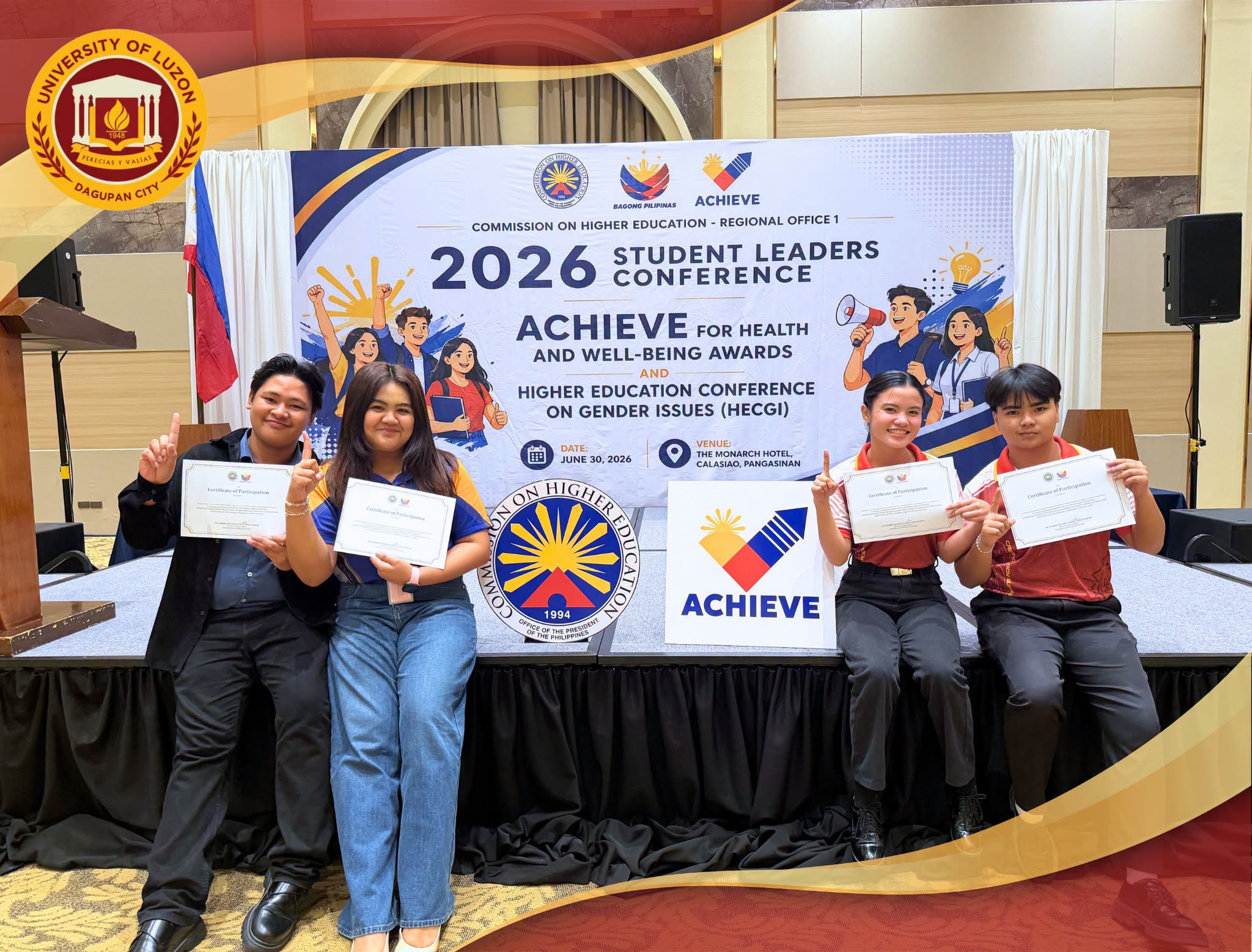
Demonstrating its unwavering commitment to student welfare, leadership development, and inclusive education, the University of Luzon participated in the 2026 Student Leaders Conference, ACHIEVE for Health and Well-Being Awards, and Higher Education Conference on Gender Issues organized by the Commission on Higher Education (CHED). The event was held at the Monarch Hotel in Calasiao on June 30, 2026.
The conference gathered Student Affairs Services Coordinators or PADS Focal Persons and student leaders from Higher Education Institutions across Region I to discuss emerging issues, best practices, and policy directions that promote student development and institutional excellence. Representing the University of Luzon were Mr. Jove II Bulatao and student leaders Trisha Rodas from the College of Liberal Arts, and RJ Escaño and Mae Bandong from the College of Criminology.
The seminar aimed to provide professional training for Student Affairs Services Coordinators while recognizing students as the primary stakeholders of programs implemented by institutions. During the conference, Dr. Cherrie Melanie Ancheta-Diego, CESO III, Director IV of CHED RO1, emphasized that the guidelines are not only for compliance but more importantly, to champion student welfare and development. The seminar highlighted various issues, policies, and procedures that Higher Education Institutions must implement in accordance with the rule of law.
Thematic Session 1: Pathway to Health and Well-being
Ms. Rita Sescar, Chief Education Program Specialist of CHED-OSDS, highlighted that Higher Education Institutions should produce RADIANT students — Resilient, Aware, Digitally Literate, Inclusive, Active, Nurturing, and Transformative. The University of Luzon actively adapts to learners’ educational needs and continuously implements educational strategies that improve academic performance while fostering a nurturing learning environment.
Thematic Session 2: RA 11053 – Anti-Hazing Act of 2018
Atty. Premier Dee Ewigkeit Castro, Regional Director of PAO RO1, focused on legal education on the Anti-Hazing Act, the importance of registration of organizations, and activity monitoring to prevent organized crime and unlawful practices. The University of Luzon remains firmly against interpersonal violence and all forms of abuse, assault and harassment that fall under the definition of hazing; and continues to implement strict monitoring mechanisms to ensure that there is no room for negligence.
Thematic Session 3: Building Informed and Responsible Youth: Understanding HIV and AIDS Policies and Prevention Strategies
Dr. Paula Paz M. Sydiongco, MD, MPH, MBA, CESO IV, Regional Director of DOH RO1, discussed health education and the differences between the two STD; data monitoring on individuals with HIV and AIDS; and the role of institutions in preventing further transmission of sexually transmitted diseases. The University of Luzon remains committed to cultivating a school environment free from discrimination and to implementing policies that ensure confidentiality and respect for all members of the academic community.
Thematic Session 4: RA 11313 – Safe Spaces Act (Bawal Bastos Law)
Atty. Dessa Estrada, Educational Supervisor II of CHED RO1, discussed gender based sexual harassment in public space, including but not limited to school premises; the actions and support that institutions can provide to victims of sexual abuse; and the importance of community participation in ensuring the safety and protection of all individuals, especially in public space.
Thematic Session 5: CHED Requirements for Student Affairs and Services (SAS)
Dr. Angelica Q. Dolores, Supervising Education Program Specialist of CHED RO1, discussed the multi-faceted functions of the Office of the Student Affair, including educational reforms that prioritize the health and well-being of the students; placement strategies and alumni tracking to ensure graduates’ occupational safety in labor markets; and the implementation of practical training programs that support job search and employment opportunities for new graduates.
Armed with the valuable knowledge and insights gained from the seminar, the University of Luzon remains committed to fulfilling the educational needs of its students. The University continuously implements educational reforms and strengthens existing strategies, policies, and programs that promote holistic student development and lifelong learning.
The University of Luzon’s participation in this seminar further highlights its dedication to advancing the United Nations Sustainable Development Goals (UN SDGs), particularly SDG 3 (Good Health and Well-Being) through student welfare initiatives, SDG 4 (Quality Education) through continuous educational improvement, SDG 5 (Gender Equality) through the promotion of safe and inclusive spaces, SDG 8 (Decent Work and Economic Growth) through career readiness programs, SDG 10 (Reduced Inequalities) through inclusive student support, SDG 16 (Peace, Justice, and Strong Institutions) through the promotion of student rights and safety, and SDG 17 (Partnerships for the Goals) through collaboration with government agencies and stakeholders.
Through active engagement in policy discussions and professional development initiatives, the University of Luzon continues to champion a student-centered, inclusive, and transformative educational environment that prepares learners not only for academic success but also for responsible citizenship and meaningful contributions to society.