
University of Luzon Implements Community Livelihood and Eco-Innovation Initiative
Posted on 30th of Nov 2025 by UL Administrator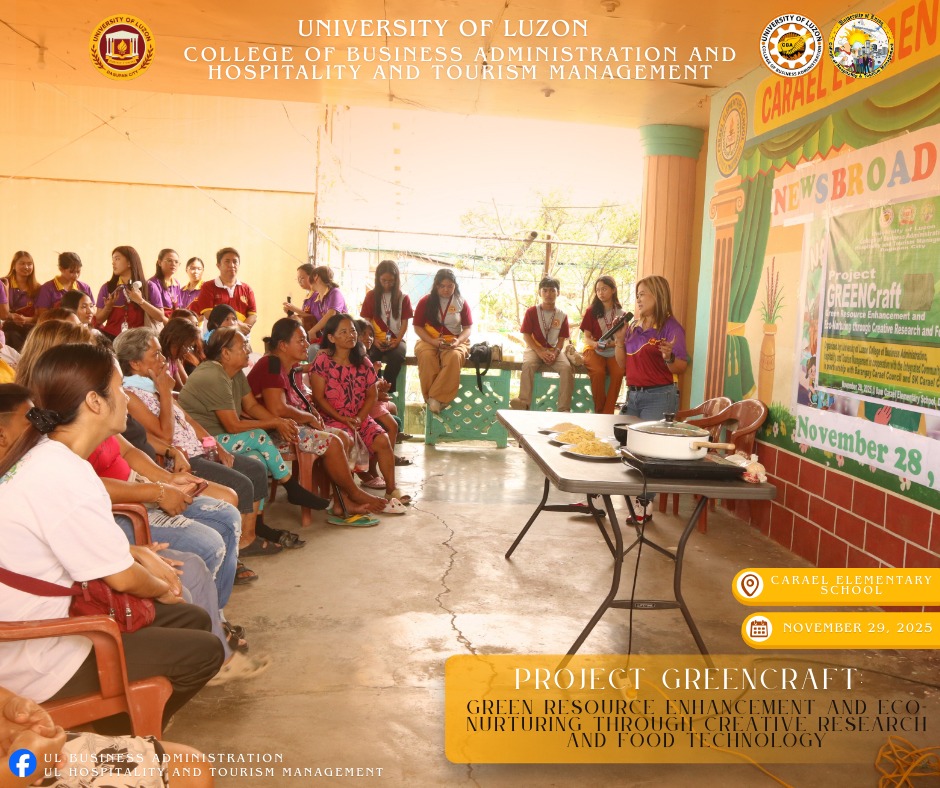
The University of Luzon (UL) reaffirmed its commitment to community development and ecological stewardship with the successful execution of Project GreenCraft 2025: Green Resource Enhancement and Eco-Nurturing through Creative Research and Food Technology. Held on Saturday, November 29, 2025, at the Carael Elementary School in Dagupan City, this impactful initiative was spearhead by the UL College of Business Administration, Hospitality and Tourism Management (ULCBAHTM) in close collaboration with the Integrated Community Extension Services. The project operated in meaningful partnership with the Barangay Carael Council and the SK Carael Council, showcasing a united approach toward sustainable community empowerment. The core mission of the project was to translate academic knowledge into tangible livelihood opportunities while promoting the sustainable use of local resources among the residents of Barangay Carael.
The educational centerpiece of Project GreenCraft 2025 featured the talented 4th Year Hospitality Management students, a group of dedicated Luzonians who eagerly shared their technical skills with participating mothers from the Barangay Carael community. The practical seminar focused on the production of innovative Labong Bukayo, a creative culinary adaptation of a traditional Filipino delicacy. By incorporating labong (bamboo shoots), a readily available resource, the students demonstrated how to transform a common, often underutilized, ingredient into a delicious, high-value product. This training was designed not merely as a cooking class but as a vital seed for entrepreneurship, equipping the mothers with a marketable skill that could serve as an extra source of income, thereby fostering economic resilience within their households. The atmosphere throughout the day was one of dynamic interaction, enthusiasm, and palpable success, culminating in the joyous tasting of the Labong Bukayo which was universally praised by all participants and partners.
The success of this comprehensive community effort is attributed to the dedicated leadership and mentorship provided by key University and community figures. Special acknowledgment is extended to Dr. Amalia G. dela Cruz, Dean of the CBAHTM, and Dr. Carmelo John E. Vidal, Director of Extension Services and Dean of the Graduate School, whose administrative support was crucial to the project’s framework. Further guidance was provided by Dr. Sherryl Delos Santos, Program Head of the ULCBA, and Prof. Alvin O. Carillo, Faculty Coordinator for Community Extension Services at ULCBAHTM. Prof. Marvex P. Cacanando served as a distinguished Faculty Member, while Mr. John Patrick Delos Santos, SK Chairman, provided indispensable community linkage. The hands-on training was expertly delivered by the trainers, Ms. Rochelle Baloncia, Ms. Mary Jane Rosario, and Ms. Lorraine Kyla Domantay, who ensured the effective transfer of skills. This collaborative structure exemplifies the University of Luzon’s holistic approach to academic extension and public service, positioning its Luzonians as active agents of positive social change.
This initiative comprehensively supports the global agenda of the United Nations Sustainable Development Goals (SDGs), demonstrating how targeted local action drives international objectives. Project GreenCraft 2025 directly addresses SDG 1 (No Poverty) by providing livelihood training, creating immediate, sustainable extra income streams for community members. It furthers SDG 4 (Quality Education) by facilitating the transfer of specialized, practical knowledge from university students to adult learners, ensuring inclusive and equitable learning opportunities for all. The focus on entrepreneurship and skills development aligns perfectly with SDG 8 (Decent Work & Economic Growth), stimulating grassroots economic activity. The development of innovative Labong Bukayo represents an advancement in creative food technology and resource utilization, thereby contributing to SDG 9 (Industry, Innovation & Infrastructure). Finally, by strengthening robust community partnerships between the University, the Barangay Council, and the Sangguniang Kabataan (SK) Council, the project reinforces the principles of inclusion, resilience, and sustainability outlined in SDG 11 (Sustainable Cities & Communities).
Latest Video AD
Latest Gallery

Message from
the President
"We are committed in providing our students the best education possible –from their first day in school to the day they start their careers. It’s actually a task we’ve been doing since its inception in 1948"